
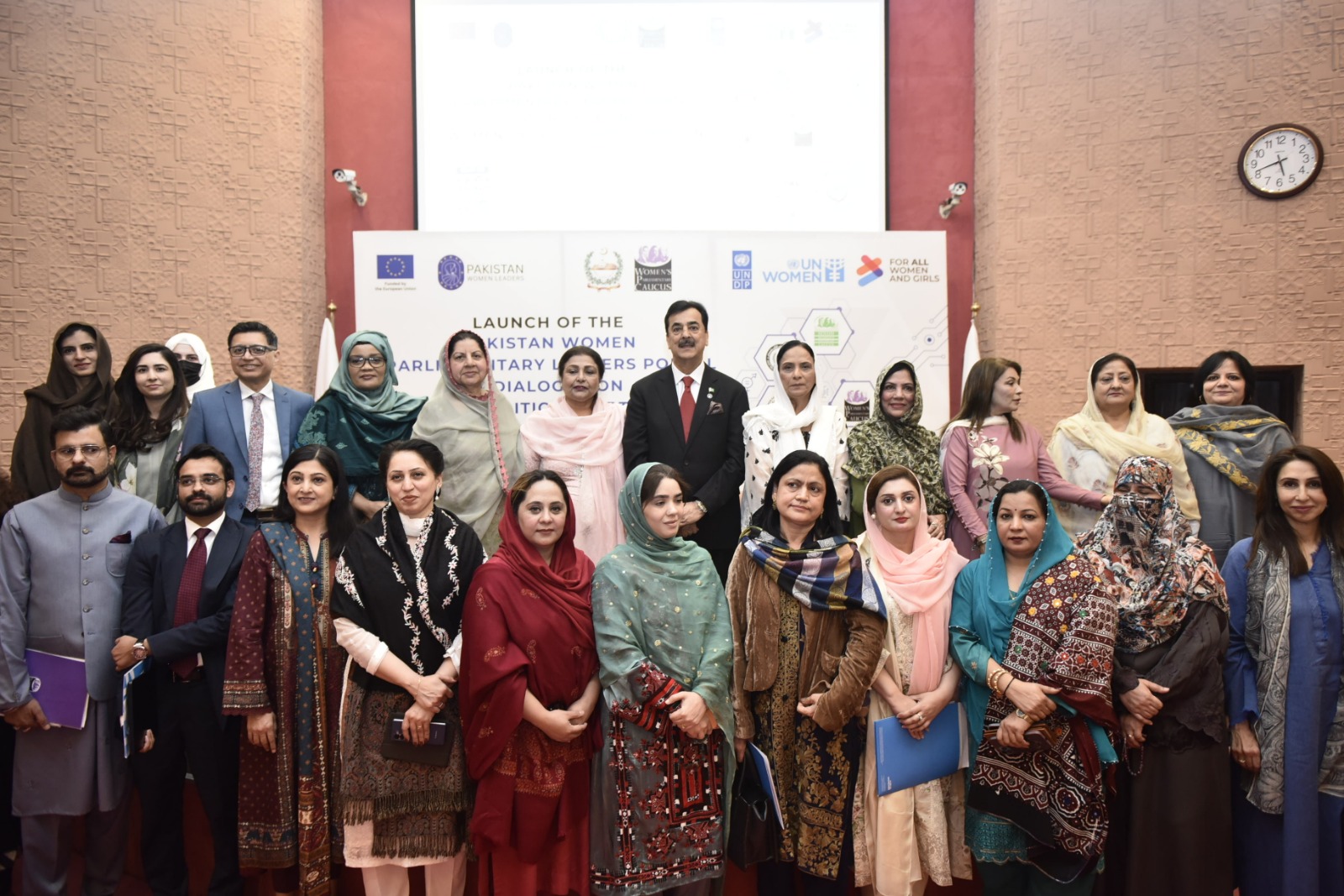
On March 6, 2026 in Islamabad the Women’s Parliamentary Caucus of the National Assembly launched the Women Parliamentary Portal and held a high-level dialogue on women’s political participation, in partnership with UN Women and the European Union. The initiative, announced by Dr. Shahida Rehmani, aims to move beyond numerical representation to ensure meaningful and effective participation of women parliamentarians across Pakistan.
Dr. Shahida Rehmani underlined that the quota system has expanded women’s presence in legislatures but must be complemented by reforms and support mechanisms that enable full engagement in lawmaking and oversight. The Women Parliamentary Portal will act as a central resource to strengthen coordination among national and provincial Women’s Parliamentary Caucuses, showcase legislative contributions, and create opportunities for policy dialogue and citizen engagement.
Key features of the Women Parliamentary Portal include legislative mapping of pro-women laws, gap analysis with actionable recommendations, mentorship programs and online courses, and tools to support gender-responsive budgeting and preserve institutional memory. The bilingual platform is accessible to visually impaired users and is designed to connect legislators, researchers and civil society to improve coordination between federal and provincial lawmakers for more effective lawmaking.
The ceremony’s keynote speaker, Syed Yousaf Raza Gilani, said democracies thrive when women share decision-making equally and stressed that sustainable development requires women’s political and economic empowerment. Recalling past reforms and social initiatives, he paid tribute to pioneering leaders and affirmed the importance of women’s presence in Parliament, stating ‘Opportunity must be determined not by gender, but by merit and determination. Women of Pakistan are not waiting—they are shaping the future and defining democracy.’
Barrister Aqeel Malik, Minister of State for Law & Justice, highlighted the expanding role of women parliamentarians who engage with constituencies, contest elections and influence party politics beyond reserved seats. He described the Portal as a forward-looking tool that will enhance coordination, knowledge sharing and the passage of gender-responsive legislation across federal and provincial assemblies.
The launch included a panel discussion moderated by Syed Shamoon Hashmi and featuring legislators and advocates such as Begum Ishrat Ashraf, Shaista Pervaiz, Dr. Nafisa Shah, Tanzila Um-e-Habiba, Ghazala Gola, Naeema Kishwer Khan and Samina Khalid Ghurki. Speakers called for political and financial support for women legislators, removal of structural barriers and stronger efforts to empower women from middle- and lower-middle-class backgrounds to take part in collective decision-making. Dr. Nafisa Shah also voiced concern over the recent martyrdom of schoolgirls in Iran and urged international action to protect women and children.
The event was attended by members of the National Assembly including Kiran Haider and Shahnaz Saleem Malik, UN and EU representatives, civil society members, youth and media. By providing mentorship, research tools and a public interface linking citizens with legislators, the Women Parliamentary Portal seeks to institutionalise support for women leaders and sustain progress in Pakistan’s democratic governance.
Share this content:
Leave a Reply