
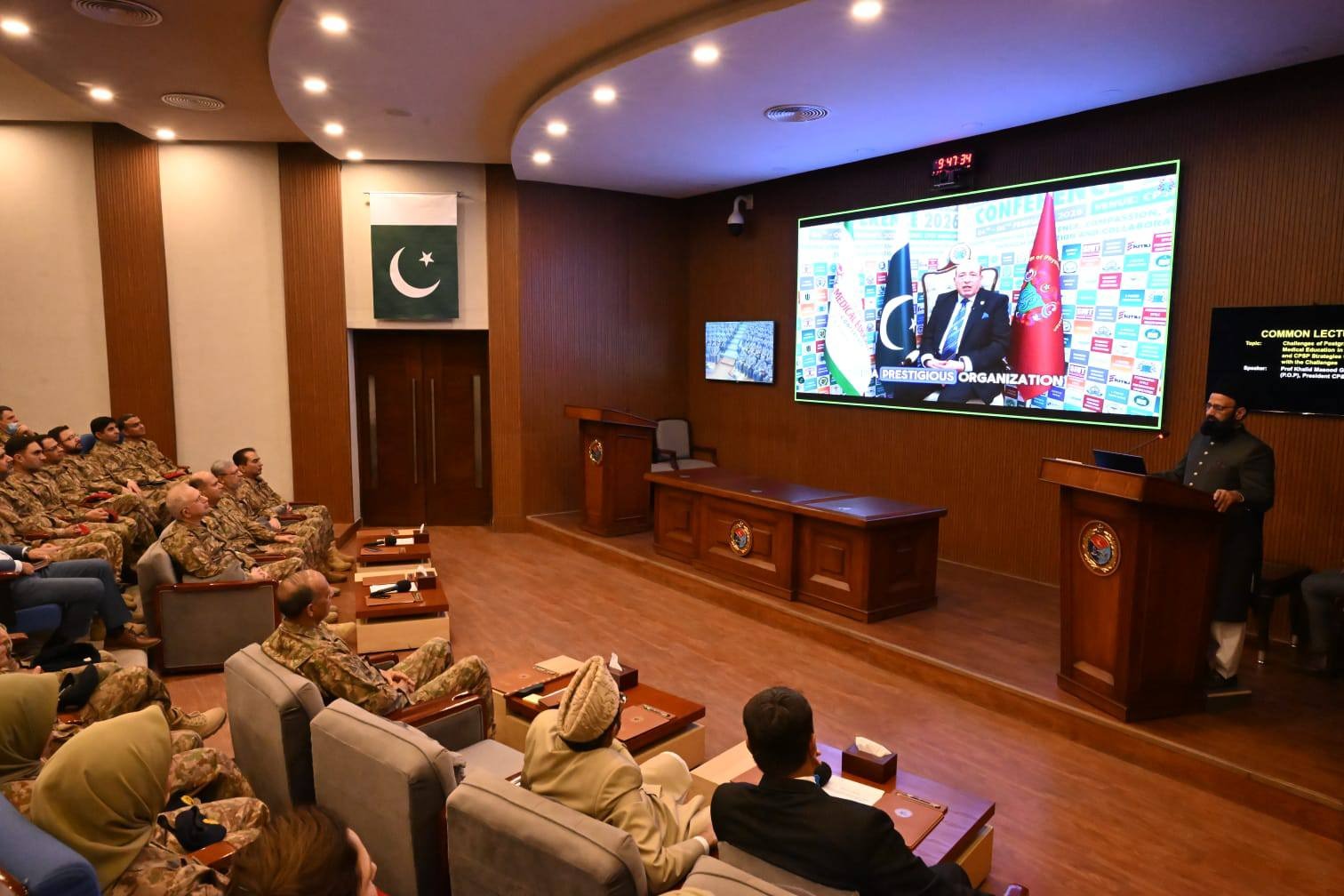
Prof. Khalid Masood Gondal, President of the College of Physicians and Surgeons Pakistan, delivered a wide-ranging lecture at the Armed Forces Post Graduate Medical Institute Rawalpindi on challenges and strategies for postgraduate medical education. Invited by Commandant AFPGMI Maj. Gen. Muhammad Rafique, Prof. Gondal addressed postgraduate doctors, senior specialists and administrative medical leadership, while accompanied by Senior Vice President and Regional Director Islamabad Prof. Muhammad Shoaib Shafi.
The talk, which was streamed live via Zoom to ten peripheral tertiary care hospitals, paid tribute to the College’s founders and past leaders, including Lt-Gen. Wajid Ali Burki and former presidents whose work shaped current standards. Participants engaged from the auditorium and online, reflecting broad interest in improving postgraduate medical education across Pakistan.
Prof. Gondal examined global and regional challenges facing postgraduate medical education, covering induction and training phases, accreditation, curriculum design, supervision, monitoring and evaluation. He outlined how the College is adopting Competency Based Medical Education to align training with international standards and ensure consistent competencies among trainees nationwide.
The President described institutional measures such as the Department of National Residency Program to oversee quality and standards, the Directorate of Medical Education to supervise training courses and curriculum updates, and the Advanced Skills Department that delivers courses including BLS, ACLS, ATLS, PALS, BBV and ALSO. Emphasis was placed on transparent accreditation, re-accreditation and de-accreditation processes to maintain programme integrity.
Quality assurance measures highlighted by Prof. Gondal include strict trainer to trainee ratios, structured methods for critical appraisal of examinations, and active involvement of foreign examiners in fellowship assessments. He cited statistical growth and the College’s current conduct of 90 fellowship programs, comprising 46 first fellowship and 44 second fellowship specialties, as evidence of expanding capacity while maintaining standards.
Faculty development and assessment reforms were presented as key priorities. Prof. Gondal described implementation of workplace based assessment, monitoring of supervisors, enhancement of the MCQ bank, master trainer workshops for supervisors and examiners, and a comprehensive revamp of curricula to meet evolving clinical needs. These steps, he argued, are central to strengthening postgraduate medical education across regions and centres.
The College’s regional and international centres play a vital role in delivering training and upholding standards, and Prof. Gondal reaffirmed ongoing collaborations with bodies such as WFME, ACGME, ACCME and IAMRA. He noted active partnerships with institutions in Ireland, the UK, the Middle East and SAARC countries, and cited participation of international medical education leaders in recent conferences as a sign of constructive global engagement.
Throughout the session Prof. Gondal underscored CPSP’s commitment to transparency and excellence in training, monitoring and evaluation. He closed with the remark, “CPSP’s greatest strength is not the example of power but the power of our own example,” and engaged in a robust question and answer exchange with attendees. The event concluded with presentation of souvenirs by Commandant AFPGMI to the guest speakers and a vote of thanks, reflecting the lecture’s practical impact on the professional development of Pakistan’s medical fraternity.
Share this content:
Leave a Reply